New Delhi: The effectiveness of a modern air-defence network is increasingly measured not simply by how many incoming targets it can destroy, but by how efficiently it can deploy limited and expensive interceptors against a diverse range of threats.
India’s experience during Operation Sindoor, as described in the source material, highlights the importance of a layered air-defence architecture in which high-end missiles are reserved for the most dangerous targets, while guns, electronic warfare systems and lower-cost interceptors tackle drones and other lower-tier threats.

At the centre of this architecture are the Indian Air Force’s Integrated Air Command and Control System (IACCS) and the Army’s Akashteer network, which provide the command-and-control backbone for coordinating multiple air-defence assets.
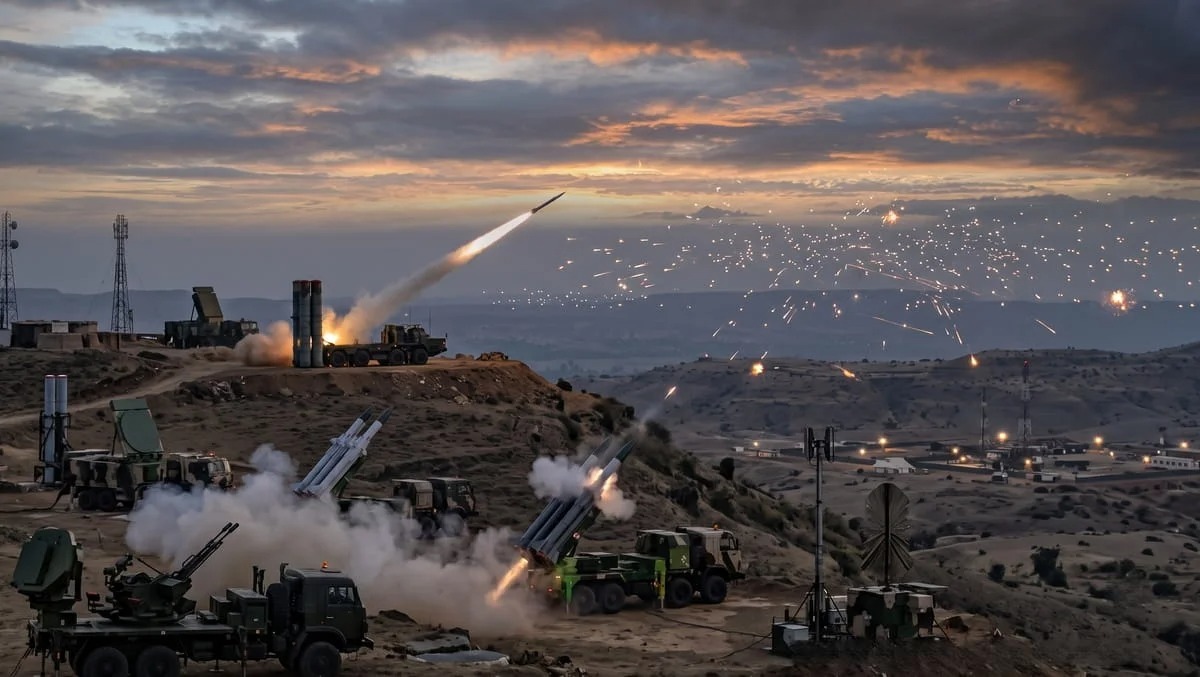
The network brings together systems including the S-400, Medium-Range Surface-to-Air Missile (MRSAM), Akash and Spyder, along with conventional anti-aircraft guns.
Gulf-Scale Barrage Offers a Stress Test
The scale of a modern saturation attack can be illustrated by a hypothetical Gulf-scale scenario involving around 3,713 aerial threats, including at least 623 ballistic missiles, 35 cruise missiles and more than 2,000 drones.
At a notional 90% interception rate, around 3,342 targets would have to be neutralised. However, such a scenario does not imply that an air-defence network should maintain thousands of expensive surface-to-air missiles.
Instead, the key is to assign the right weapon to the right threat.
Ballistic Missiles Require the Highest-End Defences
Ballistic missiles represent some of the most demanding targets for an air-defence system because of their speed and flight characteristics.
In the hypothetical scenario, neutralising 90% of 623 ballistic missiles would mean successfully intercepting approximately 561. If planners account for unsuccessful engagements and multiple-interceptor doctrines, the number of missiles required could rise substantially.
The source material identifies the S-400 and India’s planned indigenous Project Kusha as critical components of this high-end layer. Project Kusha is described as being intended to provide interception ranges of up to 350-400 km.
These systems would be most valuable against ballistic missiles, high-value aircraft and other sophisticated threats rather than being expended against inexpensive drones.
Cruise Missiles Demand a Different Layer
Cruise missiles pose a separate challenge because they can fly at low altitude and exploit terrain to reduce detection opportunities.
The hypothetical scenario includes 35 cruise missiles, with approximately 32 needing to be intercepted to achieve a 90% success rate. The source estimates that planners could allocate 40 to 60 medium- or long-range interceptors for this threat category.
Systems such as MRSAM and Akash can provide an important middle layer, offering additional engagement opportunities against cruise missiles, aircraft and larger unmanned aerial vehicles.
Drone Swarms Create the Biggest Numbers Challenge
Large drone swarms present a fundamentally different economic problem. Using expensive SAMs against thousands of relatively inexpensive drones could rapidly exhaust missile stocks.

The scenario envisages more than 2,000 drones, requiring a correspondingly large number of engagements. A two-interceptor approach against every drone could consume thousands of missiles.
This is where the lower tiers of the air-defence network become essential. Rapid-fire anti-aircraft guns, electronic-warfare jammers, counter-UAS systems and affordable short-range missiles can handle high-volume threats without consuming premium interceptors.
The source material points to Operation Sindoor as an example of the value of combining sophisticated systems with relatively inexpensive terminal-defence capabilities.
A Layered Architecture for India
The hypothetical architecture outlined in the source divides the defensive burden across several layers.
The long-range layer, comprising systems such as the S-400 and Project Kusha, would focus on ballistic missiles and advanced combat aircraft. The proposed inventory in the scenario is 700-1,000 interceptors.
The medium-range layer, centred on MRSAM, could involve 500-800 interceptors for cruise missiles, aircraft and larger UAVs.
The short-range layer, including Akash and Akash-NG, could employ 800-1,200 interceptors against cruise missiles and medium-sized drones that penetrate the outer defensive rings.
At the terminal level, anti-aircraft guns, electronic warfare and counter-UAS systems would provide high-volume protection against smaller drones and saturation attacks.
The layers would not operate independently. A target missed by an outer defensive system could be engaged by another system closer to the defended area.
Command and Control Remains Critical
The effectiveness of such a network ultimately depends on its ability to detect, identify and assign targets rapidly.
IACCS and Akashteer are designed to integrate radar information and coordinate air-defence assets, allowing commanders to match threats with appropriate weapons.
The broader lesson from large-scale drone and missile attacks is that no single air-defence system can provide an economical answer to every threat.
A resilient shield requires a combination of long-range interceptors, medium- and short-range missiles, guns, electronic warfare and counter-drone capabilities, all connected through an integrated command-and-control architecture.
The central principle is straightforward: expensive high-end interceptors should be conserved for high-value threats, while lower-cost systems handle the volume of smaller targets. This layered approach can help preserve interceptor stocks while maintaining the ability to withstand a complex and sustained aerial assault